 Lucknow Lens
Lucknow's heat, explained
Short answer: Lucknow's summer nights are getting hotter, even though its hottest days aren't. Nights that stay at 28 °C or more have gone from about 30 a year (1980–2009) to 47 a year since 2016, and days that feel like 45 °C or more from about 8 to 18. At night the city's ground stays about 2.7 °C warmer than the countryside around it. By day, trees are the city's air conditioning: tree-covered ground is about 3.1 °C cooler than built-up ground.
What the data shows
nights a year now stay at 28 °C or more (average since 2016), up from about 30 in 1980–2009. Hot nights stop people recovering from the day's heat.
See the evidenceas many days now feel like 45 °C or more, once humidity is counted: 18 a year since 2016, against 8 in 1980–2009. Days of 42 °C+ air temperature haven't increased.
See the evidencewarmer at 1:30 am inside the city than in the countryside around it, in April–June (NASA's MODIS satellite). The gap has grown from 2.1 °C in the mid-2000s to 3.1 °C.
See the evidencecooler: tree-covered ground in the city on a summer morning, compared with built-up ground. Water is about 4.3 °C cooler. Coolest areas: Shankar Purwa 1st, Cantonment, Raja Ram Mohan Rai.
See the evidenceThe evidence
Open any finding to see the charts and numbers behind it.
Hotter nights, not hotter days
Reanalysis weather records for Lucknow (ERA5, from 1950) show the change is at night. Nights with a low of 28 °C or more averaged 30 a year in 1980–2009 and 47 a year from 2016 to 2025; 2024 had the most (69). Days reaching 42 °C have not become more common: 24 a year in the 1950s and '60s, 11 in 1980–2009, 13 since 2016.
Days reaching 42 °C
ERA5 is a reconstruction on a grid about 25 km wide, so it smooths out the hottest spots and runs 1–2 °C cooler than a city thermometer on the hottest days. That's why thresholds of 28 °C and 42 °C are used here rather than the 45 °C+ days in the news. The counts are comparable from year to year.
Humid heat is rising fastest
"Feels like" (apparent) temperature combines heat with humidity and wind. Days when it reached 45 °C rose from about 8 a year in 1980–2009 to 18 a year since 2016. Humid heat is harder on the body than dry heat, because sweat evaporates less.
The city holds its heat after dark
NASA's Aqua satellite measures ground temperature at about 1:30 pm and 1:30 am. Averaged over April to June each year since 2003, the ground inside the city boundary was 2.7 °C warmer at night than the countryside more than 5 km outside it (median 24.4 °C against 22.0 °C). By day the difference is smaller, 1.6 °C, because dry, bare fields heat up almost as fast as roofs and roads. Concrete and asphalt store the day's heat and release it at night, which is why the city's nights, not its afternoons, set it apart.
The gap has widened as the city has grown: from 2.1 °C in 2003–2007 to 3.1 °C in 2022–2026, about +0.4 °C per decade.
MODIS pixels are 1 km, so this compares neighbourhoods, not streets. The countryside pixels include villages and new suburbs, so if anything the true city-to-farmland gap is larger.
Where the city is hottest and coolest
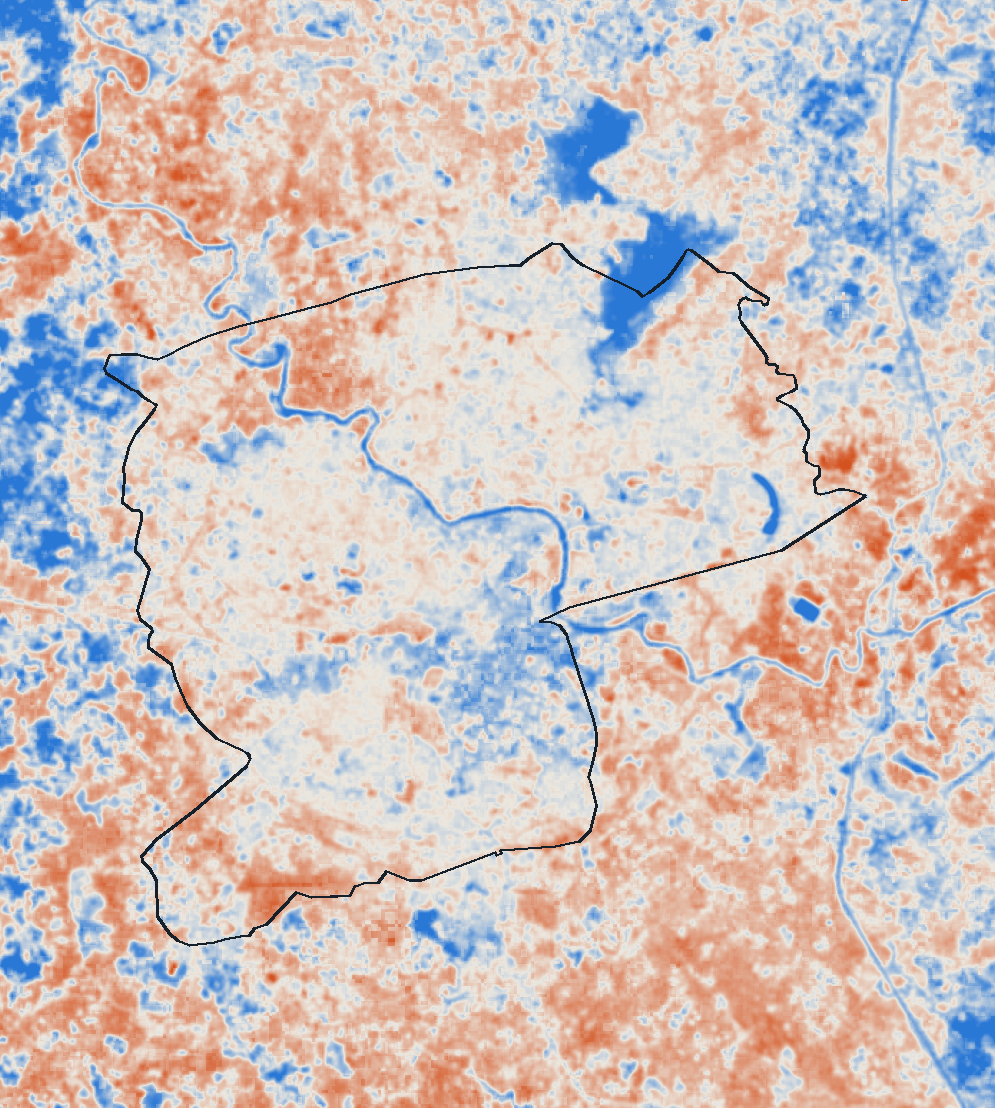
Landsat satellites measure ground temperature at 30 m resolution at about 10:30 am. Using the clearest April–June image of each year (13 images, 2014–2026), tree-covered ground inside the city was a median 3.1 °C cooler than built-up ground, and water 4.3 °C cooler. Dry farmland outside the city is the hottest surface of all in the pre-monsoon months, about 1.4 °C hotter than the city's built-up areas.
Compared with built-up ground in the city (median of the 13 summers):
Hottest wards
Coolest wards
Each ward's median ground temperature minus the whole city's, averaged over all 13 images. Wards with more tree cover run cooler (correlation -0.39). Ward names and boundaries are DataMeet's older edition and may differ from today's wards. Ground temperature on a sunny morning is not the same as air temperature, but it tracks how much heat a place absorbs.
Quick answers
Are Lucknow's summers getting hotter?
The nights are. Nights that stay at 28 °C or more rose from about 30 a year in 1980–2009 to 47 a year since 2016, and days that feel like 45 °C or more (heat plus humidity) from 8 to 18. Days reaching 42 °C have not become more common than in the 1950s–2000s.
Which areas of Lucknow are the hottest?
By satellite ground temperature on summer mornings, the hottest wards were Airport, Faizullah Ganj 2nd, Raja Bijli Pasi, Ambedkar Nagar 1st, and the coolest Shankar Purwa 1st, Cantonment, Raja Ram Mohan Rai, Ram Tirath. Areas with more trees and water run cooler: tree-covered ground is about 3.1 °C cooler than built-up ground.
Is Lucknow an urban heat island?
Yes, at night. NASA's MODIS satellite shows the ground inside Lucknow stays about 2.7 °C warmer than the surrounding countryside at 1:30 am in April–June. By day the gap is smaller (1.6 °C), because dry fields heat up almost as much as the city. The night-time gap has grown from about 2.1 °C in the mid-2000s to 3.1 °C recently.
How much do trees cool Lucknow?
On summer mornings, tree-covered ground in the city is a median 3.1 °C cooler than built-up ground, by Landsat satellite measurements across 13 summers.
Method and limits
- Nights and days since 1950: ERA5 reanalysis daily maximum, minimum and apparent temperature for the grid cell over Lucknow, via Open-Meteo. "Since 2016" is 2016–2025; the baseline is 1980–2009.
- Heat island: MODIS Aqua 8-day land surface temperature (MYD11A2, 1 km), April–June composites. City = pixels inside DataMeet's city boundary; countryside = pixels more than 5 km outside it, within the mapped area.
- Hot and cool areas: Landsat 8/9 Collection 2 surface temperature (30 m), the clearest April–June scene each year, 13 scenes. Land cover from Esri 10 m annual maps (nearest year).
- Limits: satellites measure the ground's skin temperature, not the air you feel; sunny-morning ground can be 10 °C+ hotter than the air. Differences between places are more reliable than the absolute numbers.